

Marsha P. Johnson
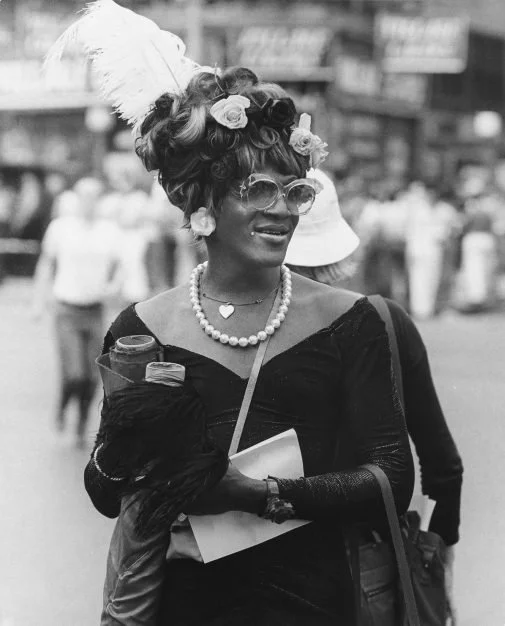
August 24, 1945 - July 6, 1992 (46)
“I’ll always be known [for] reaching out to young people who have no one to help them out, so I help them out with a place to stay or some food to eat or some change for their pocket. And they never forget it. A lot of times I’ve reached my hand out to people in the gay community that just didn’t have nobody to help them when they were down and out.”
Activist
Biography
Marsha P. Johnson (she/her) was a fearless advocate, performer, and one of the most beloved figures in the early fight for LGBTQ+ rights. Known for her radiant smile and flower-crowned presence, she devoted her life to uplifting those most marginalized in society, particularly transgender youth, unhoused queer people, and individuals living with HIV/AIDS. A symbol of resilience and radical love, Johnson’s life embodied both the pain and power of the queer liberation movement.
Marsha P. Johnson was born Malcolm Michaels Jr. on August 24, 1945, in Elizabeth, New Jersey, the fifth of seven children in a working-class African American family. Her father worked at the General Motors plant in Linden, while her mother was a housekeeper and devout member of Mount Teman African Methodist Episcopal Church, where Johnson was raised in faith. From a young age, Marsha expressed her identity through clothing that reflected her true self, often wearing dresses and accessories meant for girls. However, bullying and sexual violence forced her to hide that side of herself during childhood.
After graduating from Thomas A. Edison High School, Johnson moved to New York City in 1963 with only $15 and a bag of clothes, determined to start anew. There she began dressing in the way that felt most authentic and adopted her chosen name, Marsha P. Johnson, with the “P” standing for “Pay It No Mind,” her signature response to anyone questioning her gender. Though the term “transgender” was not yet in use, Johnson proudly described herself as a gay person, a transvestite, and a drag queen, and used she/her pronouns.
Life in New York was harsh for queer people in the 1960s, when laws still criminalized cross-dressing and same-sex relationships. Discrimination made it nearly impossible for Johnson to find steady work, and she turned to sex work to survive. It was dangerous and exploitative, yet she persevered with courage and compassion, often giving her last dollar to others in need. She slept in restaurants, hotels, and theaters, and relied on the support of friends in Greenwich Village’s queer community.
In the early days of her life in the city, Johnson met Sylvia Rivera, an 11-year-old Puerto Rican trans girl who would become her lifelong friend and co-activist. Johnson became a mentor and mother figure to Rivera, teaching her how to survive on the streets and to embrace her identity. Together, they formed a chosen family within a community that too often rejected its most vulnerable members.
In the early morning hours of June 28, 1969, police raided the Stonewall Inn, a well-known gay bar in Greenwich Village. Years of harassment and violence against LGBTQ+ people reached a breaking point as patrons and bystanders resisted. Marsha arrived at Stonewall in the midst of the chaos, later recalling that “the place was already on fire and the riot had already started.”
Though accounts differ, Johnson is widely recognized as being among the first to confront the police, standing on the front lines during the uprising. Whether throwing the first object or rallying others to fight back, her presence was undeniable. The Stonewall Uprising became the spark that ignited the modern gay rights movement and inspired the first Pride March a year later in 1970.
In the aftermath of Stonewall, Johnson joined both the Gay Liberation Front and the Gay Activists Alliance, pushing for equality across race, gender, and class lines. However, she quickly grew frustrated with the exclusion of transgender and gender-nonconforming people from these movements. In 1970 alongside Sylvia Rivera, she co-founded STAR(R), the Street Transvestite Action Revolutionaries, one of the first organizations in the United States to fight for the rights and safety of transgender people.
Through STAR(R) House, a communal shelter they established first in an abandoned truck and later in a rundown building, Johnson and Rivera provided food, clothing, and safety to unhoused LGBTQ+ youth. They funded their efforts through their own labor and sex work, often going hungry themselves so others could eat. Though STAR(R)’s physical home lasted less than a year, its impact was transformative, inspiring generations of queer mutual-aid and housing-justice projects that continue today.
Throughout the 1970s and 1980s, Marsha remained a vibrant figure in New York’s LGBTQ+ scene. She performed with the drag troupe Hot Peaches and was featured by artist Andy Warhol in his 1975 “Ladies and Gentlemen” portrait series, which celebrated drag performers and trans women of color. Despite occasional public recognition, Johnson continued to live in poverty and faced frequent arrests and institutionalization for mental health crises.
Her activism extended to the HIV/AIDS crisis of the 1980s, where she became a vocal advocate for compassion and understanding. After being diagnosed with HIV in 1990, she spoke openly about her condition, challenging stigma and fear. Her warmth, humor, and humanity endeared her to all who knew her, earning her the nickname “Saint Marsha” among the Greenwich Village community.
On July 6, 1992, Marsha P. Johnson’s body was found floating in the Hudson River near the Christopher Street piers. She was 46 years old. Police initially ruled her death a suicide, but her friends and the LGBTQ+ community widely disputed that claim, citing ongoing violence against transgender women of color. Persistent advocacy led the New York Police Department to reopen the case in 2012, though it remains officially unsolved.
In death, as in life, Marsha became a rallying cry for justice. Her story exposed the deep neglect and violence faced by transgender people, particularly Black trans women. Yet it also inspired a powerful resurgence of recognition. In 2019, New York City announced a public monument honoring Marsha P. Johnson and Sylvia Rivera, the first in the city dedicated to transgender women. In 2020, Marsha P. Johnson State Park was established in Brooklyn to commemorate her life and activism.
Today, Johnson’s image and words continue to inspire new generations of activists. Her defiant motto, “Pay It No Mind”, embodies her belief that self-acceptance is an act of resistance. Marsha P. Johnson transformed pain into purpose, fear into freedom, and love into revolution. Her life remains a testament to the enduring power of visibility, solidarity, and the fight for a world where everyone can live and love without fear.