

Alan Turing
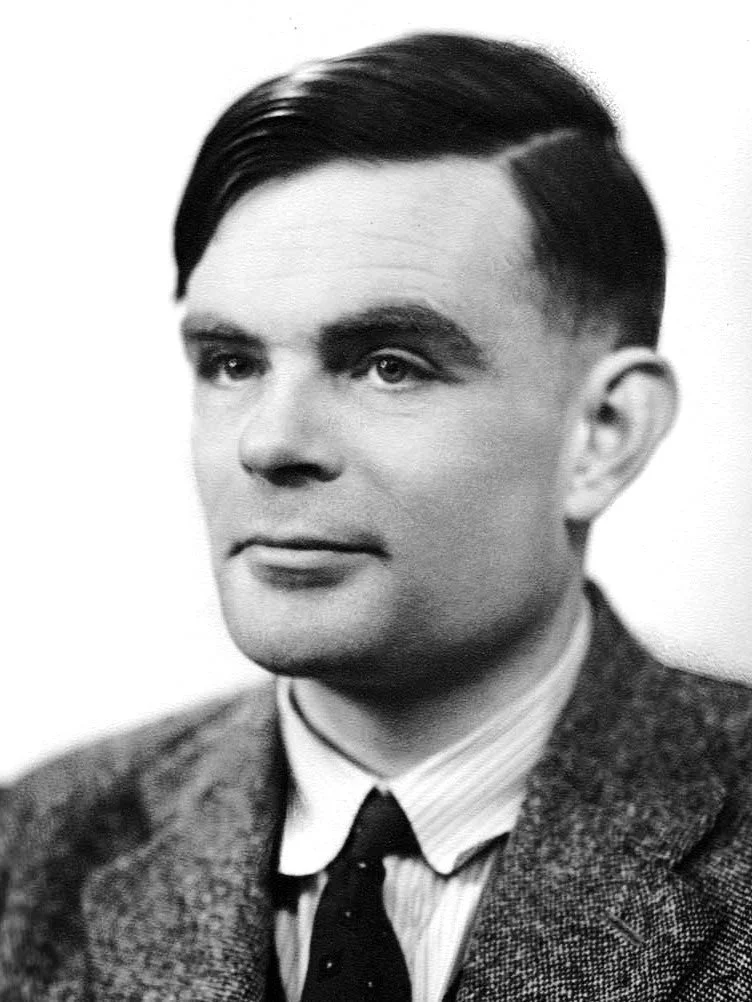
June 23, 1912 - June 7, 1954 (41)
“Sometimes it is the people no one can imagine anything of who do the things no one can imagine.”
S.T.E.M.
Biorgraphy
Picture this, someone asks you to build the most powerful computer imaginable. Alan Turing (he/him), whose reputation as a central figure in computer science and artificial intelligence has only grown since his untimely death in 1954, tackled problems like this decades before modern computers existed. His theoretical work remains the foundation of computing, AI, and modern cryptography, including standards recommended by NIST.
Turing’s genius lay in identifying what could and could not be computed. Mathematicians of his era debated whether a single, universal machine could solve all computable problems. Turing proved that it could, introducing the concept of the Turing machine: a simple device with a tape of symbols and a set of instructions that could, in principle, compute anything computable. This deceptively simple idea became the cornerstone of modern computation.
He also showed the limits of computation. For example, the Halting Problem, determining whether a program will run forever or stop, is impossible to solve algorithmically. These insights laid the groundwork for complexity theory, which underpins modern encryption and computer security. Today, cryptography relies on problems that are computationally infeasible to solve, a field Turing’s work helped make possible.
During World War II, Turing applied his intellect to cryptography at Bletchley Park, helping to break the German Enigma code. He invented the Bombe, a machine that dramatically accelerated codebreaking and is estimated to have shortened the war by 2–4 years. After the war, he helped design early computers, including the ACE at the National Physical Laboratory and software for the Manchester Mark 1. His work directly influenced modern computing.
Turing was gay, and in 1952, he was convicted of “gross indecency” for his relationship with a man. He avoided prison only by undergoing chemical castration. Tragically, he died in 1954 from cyanide poisoning, ruled a suicide. Decades later, his contributions were recognized, culminating in a posthumous royal pardon in 2013 and broader protections under the so-called “Turing Law” in 2016.
Beyond computation and codebreaking, Turing made contributions to artificial intelligence, the Turing Test, theoretical biology, probability, and number theory. His 1952 paper on morphogenesis explored how patterns and structures emerge in nature, demonstrating his ability to blend abstract theory with real-world phenomena.
Alan Turing’s legacy is vast: he defined the limits of computation, helped win a world war, and inspired the design of modern computers and artificial intelligence. The Turing Award, the highest honor in computer science, bears his name, a lasting testament to a life devoted to solving some of the most fundamental problems of logic, computation, and human ingenuity.
Alan Turing died on June 8, 1954, at the age of 41, from cyanide poisoning at his home in Wilmslow, Cheshire, England. The inquest at the time ruled his death a suicide, noting that he had ingested cyanide, likely from a vial used in his chemical experiments at home. However, later analysis has suggested that it might have been an accidental exposure, possibly linked to his work with chemicals.
At the time of his death, Turing had endured tremendous personal and professional stress. In 1952, he was convicted for homosexual acts, illegal in Britain at the time, and avoided prison only by accepting chemical castration, which had profound physical and psychological effects. His security clearance was revoked, barring him from continuing sensitive cryptographic work for the government, which had been a major part of his career and identity.
Turing’s death came just two years after this conviction, and while officially considered suicide, some historians emphasize that the exact circumstances remain uncertain, making it a tragic intersection of genius, societal prejudice, and personal struggle.