

Josephine Baker
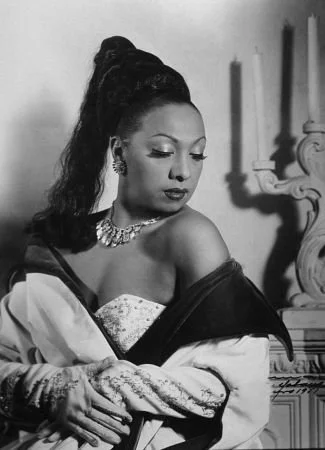
June 3, 1906 - April 12, 1975 (68)
“… I improvised, crazed by the music… Even my teeth and eyes burned with fever. Each time I leaped I seemed to touch the sky and when I regained earth it seemed to be mine alone.”
Activist/Artist/Performer
Biography
Josephine Baker (she/her) was an American-born dancer, singer, actress, World War II spy, and civil rights activist whose life and career broke racial and gender barriers across the globe. She became one of the first African American women to achieve international stardom, using her platform as a performer to advocate for racial equality, human rights, and social justice.
Josephine Baker was born Freda Josephine McDonald on June 3, 1906, in St. Louis, Missouri, to a washerwoman mother and a vaudeville performer father. She grew up during a time of intense racial segregation and poverty, often witnessing violence and discrimination, including the East St. Louis race riots of 1917. From a young age, Baker turned to performance as a way to survive and express herself. She would dance on the streets for money when work was scarce, a habit that honed her unique performance style and drew attention from local theater troupes. At age 15, she joined an African American traveling vaudeville group, leaving home to perform professionally. Around this time, she married and adopted her husband’s surname, becoming Josephine Baker.
Baker’s early career flourished in vaudeville and touring theater productions in the United States. She became a part of New York City’s Harlem Renaissance, a period of extraordinary cultural output by Black artists, where she gained recognition for her comedic timing, improvisational flair, and commanding stage presence. In 1925, Baker traveled to Paris to perform in La Revue Nègre. Her debut captivated audiences with her energetic, rhythmic dancing and playful, provocative style. Baker quickly became a sensation, particularly for her ‘Danse Sauvage’, where she danced wearing a skirt of artificial bananas. She leveraged her unique look, movement, and charisma to become one of the most sought-after performers in Europe, starring in films, cabaret productions, and concerts while befriending prominent artists, musicians, and intellectuals.
Despite her fame, Baker remained acutely aware of racial inequality. Although her audiences in France were predominantly white, her performances retained African and non-Western influences, celebrating Black culture and heritage at a time when it was often marginalized. Her artistic choices and unapologetic embodiment of Black femininity challenged stereotypes and expanded the possibilities for Black performers worldwide.
During World War II, Baker used her fame in service of the French Resistance. She performed for French and Allied troops, socialized with German military officers, and passed secret information via invisible ink on her sheet music, traveling across Europe under the guise of performance. For her bravery, she received numerous honors, including the Croix de Guerre, the Resistance Medal, and recognition from the French Committee of National Liberation.
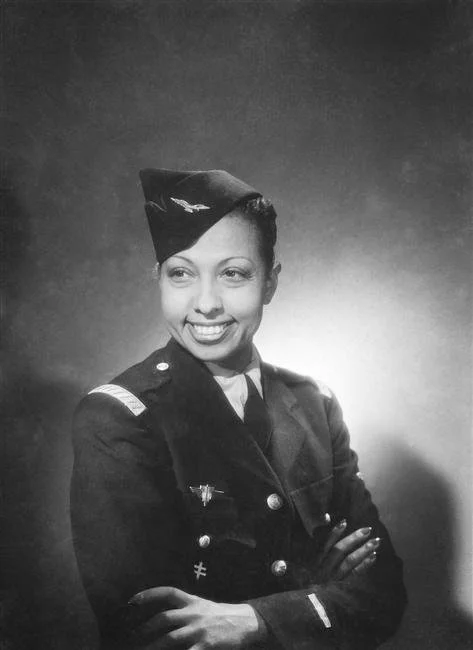
After the war, Baker returned to the United States, confronting the segregation she had left behind in St. Louis and New York. She refused to perform for segregated audiences, often pressuring venues to integrate. Baker’s activism extended to the Civil Rights Movement: she spoke at the 1963 March on Washington for Jobs and Freedom, sharing her experiences as a Black woman navigating life in both the United States and Europe. Her speech highlighted the absurdity of global fame juxtaposed with racial discrimination at home:
“You know, friends, that I do not lie to you when I tell you I have walked into the palaces of kings and queens and into the houses of presidents. And much more. But I could not walk into a hotel in America and get a cup of coffee, and that made me mad.”
Baker’s personal life mirrored her political and social ideals. She adopted 13 children from around the world, calling them her “Rainbow Tribe”, and raised them to exemplify cultural diversity and racial harmony. She continued performing well into her later years, maintaining a presence on the international stage and mentoring younger performers. Her dedication to the arts and activism made her a symbol of resilience, courage, and joy.
Baker’s final performance took place in 1975 at the Bobino Theater in Paris, a sold-out show celebrated for her enduring energy and charisma. Following the performance, she spent the night socializing with friends and fellow artists. While asleep later that night, Baker slipped into a coma and passed away on April 12, 1975, at age 68. Her death marked the end of a life defined by artistic brilliance, political engagement, and humanitarian vision. Baker’s legacy was immediately recognized in France, and decades later, she became the first Black woman interred at the Panthéon in Paris, honoring her extraordinary contributions to culture, resistance, and civil rights.
Josephine Baker’s life exemplifies how art, courage, and conviction can intersect. She transformed the world of performance, challenged racial and gender norms, contributed to the fight against tyranny during wartime, and worked tirelessly to promote equality and justice. Her story continues to inspire artists, activists, and audiences worldwide, reminding us that creativity and bravery can leave an indelible mark on history.