

Florence Nightingale
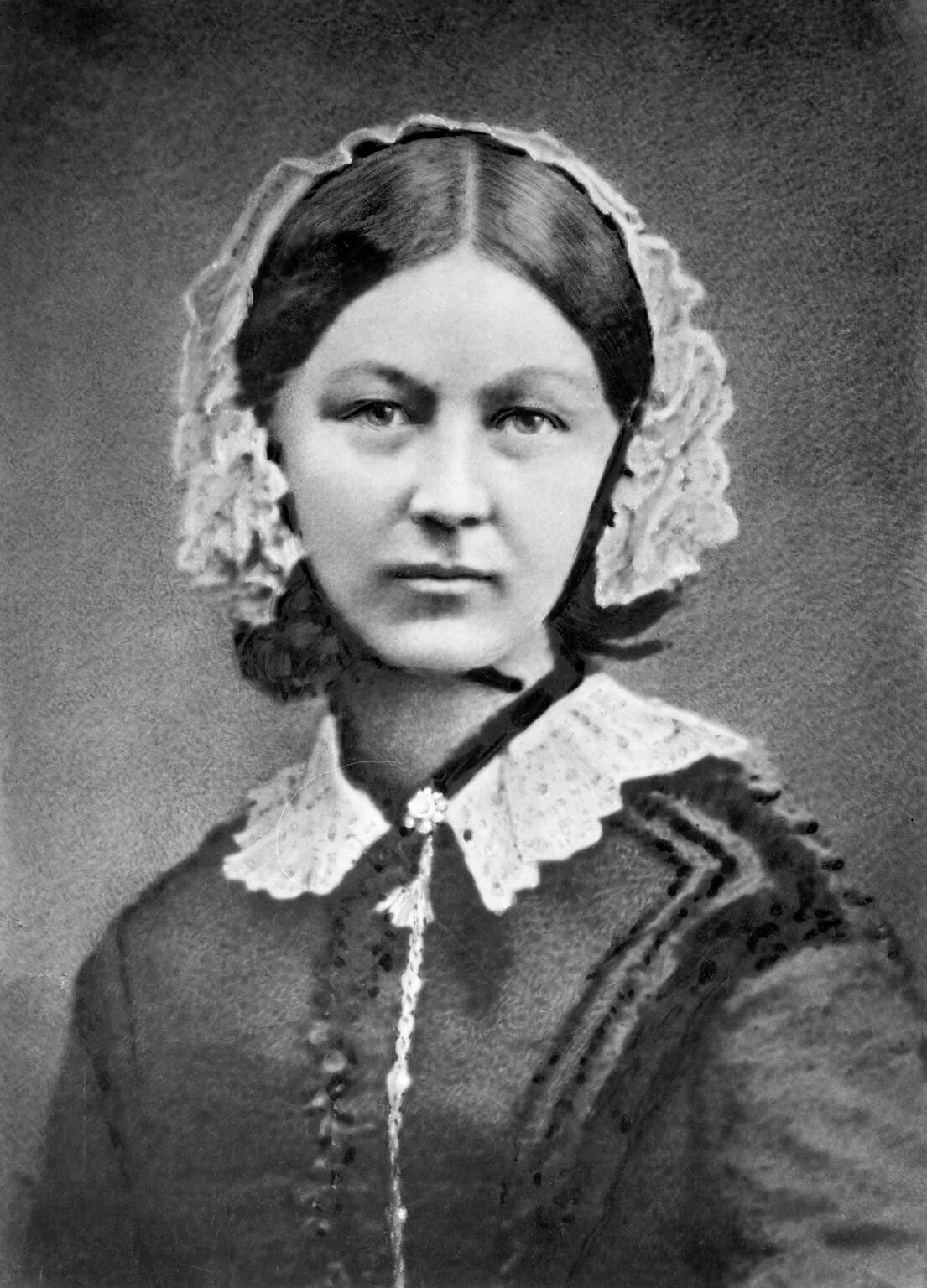
May 12, 1820 - August 13, 1910 (90)
“I am of certain convinced that the greatest heroes are those who do their duty in the daily grind of domestic affairs whilst the world whirls as a maddening dreidel.”
Healer/Humanitarian
Biography
Often called “the Lady with the Lamp,” Florence Nightingale (she/her) was a pioneering nurse, statistician, and public health reformer whose influence transformed hospitals, nursing, and patient care worldwide. Born on May 12, 1820, in Florence, Italy, to wealthy English parents, she was named after her birthplace. Educated at home, Nightingale excelled in mathematics, languages, philosophy, and religion, foundations that would later shape her groundbreaking approach to healthcare and statistics.
As a teenager, Nightingale received a “divine calling” to serve the sick and poor, despite societal expectations for women of her class to marry and raise a family. Defying her parents’ wishes, she trained in Germany at Pastor Theodore Fliedner’s hospital for deaconesses and in Paris with the Sisters of Mercy, learning both practical nursing skills and the importance of sanitation and organization. Returning to London in 1853, she became superintendent at the hospital for “gentlewomen” and quickly made a name for herself as a skilled nurse and leader.
Nightingale’s fame grew during the Crimean War (1854–1856), when she led a team of 38 nurses to treat British soldiers at the camp outside Constantinople. Facing overcrowded, unsanitary conditions and resistance from male doctors, she implemented rigorous cleanliness protocols, proper nutrition, and compassionate care. Known for checking on soldiers by lamp-light each night, she earned the enduring nickname “the Lady with the Lamp.” Within six months, the death rate dropped dramatically, from 40% to 2%.
After the war, Nightingale continued advocating for systemic healthcare improvements. She presented her findings and statistical analyses to Queen Victoria and Prince Albert, influencing the creation of a Royal Commission to reform the British Army’s medical system. She authored Notes on Nursing: What it is, and What it is Not (1859), a foundational text still in use today, and established the Nightingale Training School at St. Thomas’ Hospital in 1860, professionalizing nursing and elevating its societal status.
Throughout her life, Nightingale authored over 150 books, pamphlets, and reports on health, sanitation, and hospital administration, and she developed early versions of the pie chart to communicate data. In her later years, Nightingale’s health declined and she spent much of her time confined to her home in London, though her influence grew stronger as she continued to write, advise governments, and train nurses around the world. She died on August 13, 1910, at her residence in Park Lane, London, at age 90, with the immediate cause of death recorded as heart failure. Even in her final days, she remained an icon of humanitarian service, and her passing galvanized a nation and a profession.
Her legacy endures, from the establishment of the world’s first professional nursing school to the unveiling in 1912 of the Florence Nightingale Medal by the International Committee of the Red Cross to honour exemplary nurses worldwide. In her death, as in her life, Nightingale left an indelible mark: the transformation of nursing from a position of low status into a career of respect, the implementation of sanitary reforms that saved countless lives, and a global movement of caring professionals continuing her work today.