

Harriet Tubman
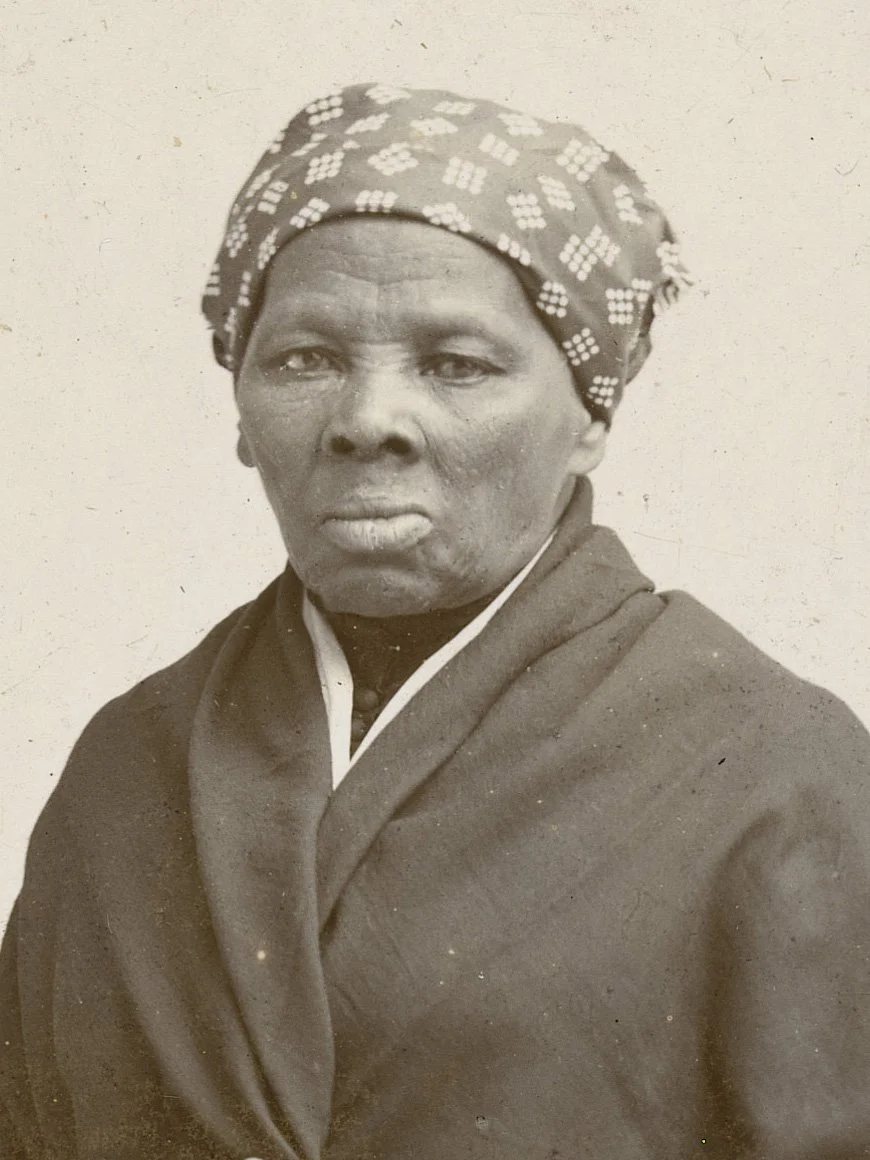
March 1822 - March 10, 1913 (91)
“I had reasoned this out in my mind; there was one of two things I had a right to, liberty or death; if I could not have one, I would have the other; for no man should take me alive.”
Activist
Biography
Harriet Tubman (she/her) was born Araminta “Minty” Ross in Dorchester County, Maryland, around 1822. Though her father was free, her mother was enslaved, making Harriet and her siblings property under Edward Brodess. Tubman endured forced labor from an early age, working as a woodcutter, pest trapper, and field hand by age ten. She preferred outdoor labor over domestic work in the “big house,” demonstrating her early resilience and independence.
At 12, Harriet intervened in a violent altercation between an overseer and another enslaved person. She was struck in the head with a heavy iron weight, causing chronic headaches, seizures, and a sleep disorder now recognized as narcolepsy. These experiences left her physically impaired yet spiritually and mentally strong; she reported vivid religious visions and dreams throughout her life, which guided her moral compass and later missions to free others.
Harriet was known by many names throughout her life, Araminta, Minty, Moses, conductor, daughter, sister, wife, mother, aunt, each reflecting her intersecting identities as a Black woman, family member, and activist.
In 1844, Harriet married John Tubman, a free Black man, and adopted his surname and the name Harriet, likely in honor of her mother. After enduring years of labor and facing the threat of her family being sold, she escaped to Philadelphia in September 1849. Her brothers initially fled with her but soon returned; Harriet completed the journey alone, traveling nearly 100 miles guided by the North Star and support from the Underground Railroad.
Tubman returned to Maryland multiple times to rescue loved ones. Over the next decade, she made more than a dozen journeys north, guiding family, friends, and other enslaved people to freedom. She carried a firearm for protection, disguised herself, and coordinated safe houses and allies, earning the nickname “Moses” for her leadership in the Underground Railroad. She famously said, “I was the conductor of the Underground Railroad for eight years, and I can say what most conductors can’t say—I never ran my train off the track and I never lost a passenger.”
Tubman’s devout faith was central to her life. Hymns, spirituals, and visions reinforced her courage and guided her actions. Her favorite hymn, “Swing Low, Sweet Chariot,” held coded messages used by freedom seekers on the Underground Railroad. Personal objects, such as her hymnal and household items preserved at the National Museum of African American History and Culture, provide insight into her domestic life, spiritual devotion, and role as a caretaker. International recognition, like the shawl gifted by Queen Victoria, underscored her impact beyond the United States.
During the Civil War, Tubman served as a nurse, cook, scout, and spy for the Union Army. She used her knowledge of native plants and survival skills to treat soldiers and guide fugitives. In 1863, she became the first woman in U.S. history to lead a military expedition, commanding Black troops in the Combahee River Raid in South Carolina, which freed over 700 enslaved people.
Despite her heroism, she was initially underpaid, receiving only $200 for her service, less than half of what white male counterparts earned. Later, as the widow of Nelson Davis, a Black Union soldier she married after the war, she received a pension that recognized her contributions.
After the war, Harriet settled in Auburn, New York, purchasing land in 1859. She cared for family members and established the Harriet Tubman Home for the Aged and Indigent Colored People, providing shelter and care to those in need. She also advocated for women’s suffrage, collaborating with leaders such as Susan B. Anthony, Lucretia Mott, and Elizabeth Cady Stanton.
Her legacy as a Black feminist icon inspired generations of artists and activists, including Betye Saar, Alison Saar, Bisa Butler, Faith Ringgold, and Elizabeth Catlett, who celebrated Tubman’s courage, strength, and leadership in works of art. Portraits, sculptures, quilts, and other creative interpretations reinforce her enduring significance as both a historical figure and symbol of liberation.
Harriet Tubman passed away on March 10, 1913, in Auburn, New York, at the age of approximately 91 from pneumonia while living at the very home she had founded to care for the aged and indigent formerly enslaved people. She was laid to rest with semi-military honours at Fort Hill Cemetery in Auburn. Her death did not mark the end of her influence but instead cemented her legacy as a symbol of freedom, resilience and moral clarity.
Today, Tubman’s life continues to inspire generations: she has been honoured with commemorative coins, memorials, and even a posthumous military rank, underscoring how her journey from enslaved person to scout, conductor of the Underground Railroad, civil-rights advocate and women’s suffrage ally transformed, not only the lives of those she freed, but the very fabric of American memory and the meaning of liberation.
Key Points
Born Araminta “Minty” Ross into slavery in Dorchester County, Maryland, c. 1822.
Suffered a traumatic head injury at age 12, causing chronic headaches and narcolepsy.
Married free Black man John Tubman in 1844; later married Nelson Davis, a Union soldier.
Escaped slavery in 1849 and returned multiple times to rescue loved ones via the Underground Railroad.
Guided over 70 people to freedom; carried a firearm and relied on religious visions to protect and guide others.
Served the Union Army as nurse, cook, scout, spy, and led the Combahee River Raid in 1863.
Founded the Harriet Tubman Home for the Aged and Indigent Colored People.
Inspired artists and activists across generations; commemorated internationally and in museums, monuments, quilts, and literature.
Myth vs Fact
Myth 1: Harriet Tubman single-handedly freed hundreds of enslaved people in one daring act.
Fact: While Tubman made numerous rescue missions, each was carefully planned with networks of allies, safe houses, and support from the Underground Railroad. Her success came from strategy, courage, and collaboration, not solitary heroism.
Myth 2: Tubman was an elderly woman in a white shawl during her Underground Railroad missions.
Fact: Tubman’s iconic image as an elderly woman came after her active years. During her missions, she was a small but muscular woman, often wearing field attire with a brightly colored bandanna, carrying heavy loads, and physically leading people to freedom.
Myth 3: Tubman was paid the same as white male soldiers and operatives for her Civil War service.
Fact: Tubman was severely underpaid for her contributions, receiving only $200 for her service, less than half of what white men earned. Recognition and pensions came decades later, often after advocacy by others.
Myth 4: Tubman never married or had a personal life.
Fact: Harriet married twice, first to John Tubman, a free Black man, and later to Nelson Davis, a Union soldier. Her domestic and family life was significant; she was also a caretaker for her extended family, balancing activism with personal responsibilities.
Myth 5: Harriet Tubman’s work was purely physical, limited to guiding people north.
Fact: Tubman was a spiritual visionary, nurse, cook, scout, and spy. Her leadership extended beyond physical guidance, she strategically planned escapes, gathered intelligence, and inspired hope and resilience through her faith and example.
Myth 6: Tubman’s legacy is only historical.
Fact: Tubman continues to influence modern civil rights, feminism, Black art, and social justice movements. Artists like Elizabeth Catlett, Alison Saar, and Bisa Butler have immortalized her courage and vision, ensuring her story remains relevant and instructive today.